
in with the old

Recently I was messaged by a client I worked with in the past asking if I was still writing, and if I’d be able to help them with some content needs they had.

This client was one of the first I ever had on Upwork (in fact, I think he was the second). The pay was great (at the time), I was enjoying the content topics and writing, and he was an easy client to work with.

However, due to personal things going on at the time that took up a lot of mental space, and a lack of true commitment to freelancing (mostly because I was overwhelmed), I didn’t provide the best experience that this client deserved. We worked together on and off for a year, and then I basically ghosted them and one year later, ended the contract.

I was shocked when he reached back out. Because while the content I provided was exceptional, the rest of the relationship wasn’t. I’m embarrassed with how I handled our contract. I’ll be honest.

But I’ve come a long way in the past year and a half. And so when I got his message asking if I could do some work, I decided that, as embarrassed as I was, it was my duty to show up and prove my worth. To repair that relationship, and in addition to providing exceptional work, go above and beyond with my customer service.

It’s just the right thing to do.

The more I think about it, I’m willing to bet that I’m not the only freelancer/business owner out there who is disappointed in themselves for how they handled a contract, sale, client relationship, whatever. We probably all have that one or two clients or customers who haunt us and keep us up at night.

Because over time, we’ve grown. We’ve gotten better. We’ve learned to thrive. And those marks on our record are hard to forget.

And this past week I realized the important thing is… you’ve grown. And you’ve gotten better. And you’ve learned to thrive.

And it’s ok to have those ghosts.

Because we were learning. We were just figuring things out. We were overwhelmed, taking on too much too fast, or drowning while trying to find the balance between life, work and side-hustle work.

It’s not ok now. I won’t accept anything but the best for my clients. And I’ll never have more ghosts that keep me up at night. (Or at least I’ll do everything I can to make sure that doesn’t happen.)

But I fully believe part of growing your business is ensuring you grow as a person, both personally and professionally. While I improve my craft and learn more about industries and writing and content, I also improve how I communicate with clients, meet deadlines, stay organized, and build relationships.

That’s what’s important.

If you have those ghosts, don’t forget them. Let them push you to grow and be better. But don’t let them hold you back. It’s part of life. It’s part of owning and growing a business. It’s part of freelancing.

Is there a point to this blog post? Not really. But I felt it important to recognize that we all mess up sometimes. We all make mistakes that we have to learn and grow from. It’s part of what we do. But as long as we don’t do it again, and are constantly improving, it’s ok.

And, it’s even better if one of those old mistakes comes back and gives you a second chance to prove yourself.
personalizing your brand

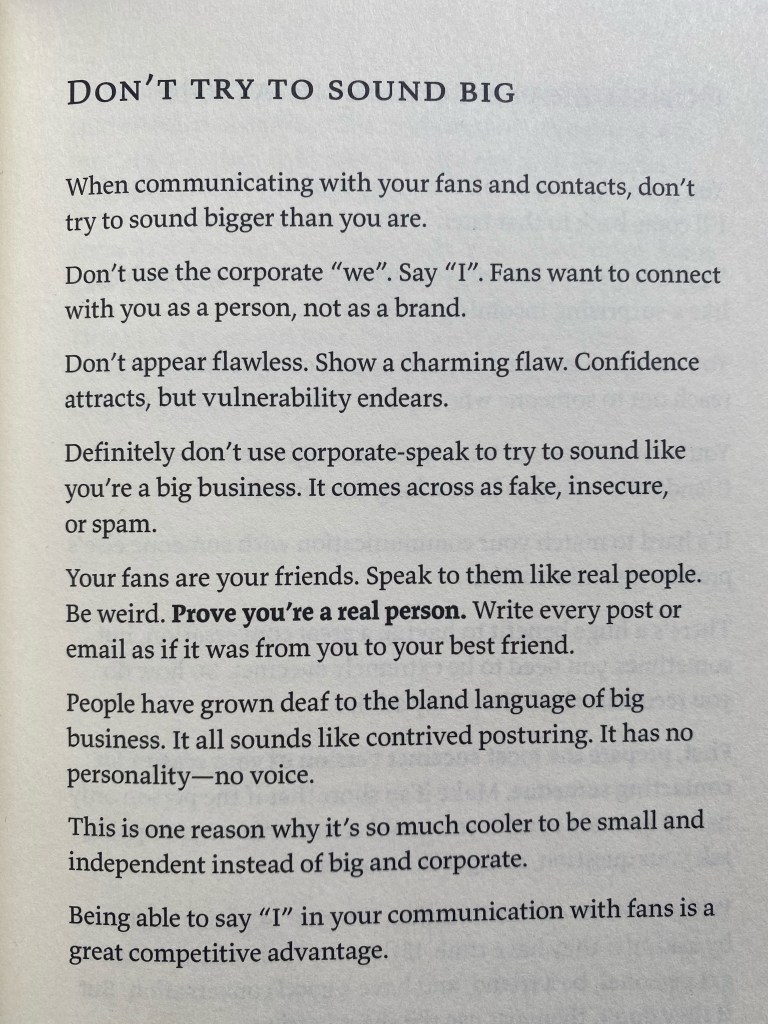
Earlier this week I posted about a chapter I read in Your Music and People: Creative and Considerate Fame by Derek Sivers. Just a few chapters later, I was inspired again and wanted to share it with you.

Because I am guilty of trying to sound big. And I’d venture a guess that, if you’re a freelancer or have your own small side-hustle, you are too.

I’ve struggled with should I say “we” or “I”? Should I speak as myself, or as a brand? Should I make myself sound bigger? Does that make my business better?

Because honestly, I am an agency of one. I am the only one who works for Callahan Communication. And I’ve wondered if that makes me look less legitimate, less trustworthy, and/or less appealing to clients.

So sometimes, when I’m writing a social media post or article for my site, I make myself sound like a larger business. (Which yes, I realize is the opposite stance I take with my blog posts.) But as I read this chapter (pictured above), I realized that while some clients may be turned off by my business of one, it’s also a huge advantage I have over others.

I’m a real person, not a huge company or brand. I’m sincere and honest. You know what you are getting if you partner with me. You can feel confident that when we sign a contract, I won’t farm the work out to a high school or college student looking to make a couple extra bucks. You can see my personality, and know exactly what I’m bringing to the table in our partnership. You can base your decision to work together off of reality, not a show put on by a marketing or PR team.

When I think about it, it is in fact much cooler to be small and independent instead of big and corporate, and I am proud to be able to say “I” in my communications and content. I’ve built this business with a lot of time, sweat and tears, and I am proud of and confident in what I provide my clients. I can showcase my passion, talent, experience and personality, and that’s one of the things that makes me a great partner.

I’ve done enough research and reading about how important it is to humanize your brand in order to connect with your audience. Consumers want to feel special, and like they are speaking to and engaging with a person, not a big company. I write about this and share it with clients. But I’m guilty of doing the opposite because I’m afraid of being small.

When in reality, I am the only human behind my brand, and everything you read from my company was written by me, for you. I want to engage with you. Educate you. Work with you. One on one. I want to help your business, make your marketing strategy better, and increase your leads and sales. And I’m excited to be able to offer that.

Moral of the story: Don’t be afraid to be small. Show your personality. Use your voice. Be a person, not a big company, no matter how large or small your company actually is. Appreciate and use your competitive advantage.

marketing = being considerate

A couple weeks ago I cruised through a book I got for Christmas – Your Music and People: Creative and Considerate Fame by Derek Sivers.

While he’s a musician writing about how to become successful as a musician, I was inspired by much of what he wrote and felt it was applicable to both myself and my side-hustle. One of the chapters I was first struck by is titled “‘Marketing’ Just Means Being Considerate.” He wrote:

Don’t confuse the word “marketing” with advertising, announcing, spamming or giving away branded crap.

Really, “marketing” just means being considerate.

Marketing means making it easy for people to notice you, relate to you, remember you, and tell their friends about you.

Marketing means listening for what people need, and creating something surprisingly tailored for them.

Marketing means getting to know people, making a deeper connection, and keeping in touch.

All of these are just considerate – looking at things from the other person’s point of view, and doing what’s best for them.

A lot of [musicians] say, “I hate marketing!” So, yah, if you thought marketing meant turning off your creativity, spending lots of money, and being annoying, then it’s a good thing you don’t like that. Nobody likes that.

Just find creative ways to be considerate. That’s the best marketing.

WOW.

I’ve been in the marketing industry for about a decade, and this perfectly sums up what my teams and I try to do every day, but in a way I’ve never thought of before. Because as marketers, we often make things more complicated than they need to be. Having the perfect creative, perfect copy, perfect landing page and calls to action, perfect audience, perfect platforms with perfect geofencing… the list goes on and on.

There is definitely a difference between ‘marketing’ and ‘advertising.’ But boiling ‘marketing’ down into those three “marketing means…” statements above hits the nail on the head.

How often, as with many aspects of life, do we make things more complicated than they need to be? Probably several times per day. Let’s take a moment to take a step back. What really matters? Why are we doing what we are doing? Who are we trying to help? What story are we trying to tell? Can it all boil down simply to being considerate? To being creative?

When applying this to your side-hustle or freelance career, think about what your ‘marketing’ and brand means. Are you making it easy for people to notice and relate to you? Will they remember you? Tell others about you? Are you listening to what people need? Getting to know them? Making connections? Doing what’s best for your clients? Until you answer yes to all of those questions, keep working. Keep striving to answer yes. Because once you do, I think you’ll find a whole new meaning to what you do.

I’m not there yet. But this year, you bet I’ll be working hard to make it.

tips for interviewing your clients

If one of your goals for 2021 is to build your book of business, hopefully you’ve already started taking steps toward accomplishing that goal. Soon, you’ll have clients accepting your bids and proposals to begin working together.

When a client reaches out to you to start a working relationship, it’s important to remember the relationship should be mutually beneficial – you get a client and a paycheck, and they get the services they need and are hiring you for.

That being said, when talking with a client and determining whether or not that relationship is the right fit, you are just as much interviewing them as they are you.

When I first started Upwork, I quickly learned I was not in charge of my own freelancer destiny… the client was. I had to apply to the job, compete with sometimes dozens of other freelancers, be interviewed by the client and even occasionally do a “test” project. Sometimes I got the contract, sometimes I didn’t. And while I’m not under the delusion that clients will come flocking to me and let me do my best work as I wanted, I had a lot less control than I had originally dreamed of.

And, letting my clients run completely run the show has led me into situations where I had to end the contract because the relationship wasn’t right (see my post on when it’s not a good fit).

What I’ve learned (sometimes the hard way) is that in order to have a lasting relationship, I must be an active participant in the beginning. I can’t just sit back and just be grateful to have the contract (though I am incredibly grateful). I have to respect and stand up for myself and my business.

Much like a traditional job interview, it’s important to do the appropriate research and ask the right questions before deciding whether to move forward working together or not.

First, research the company/person.

  • Check out their website and social media presence. Try to understand their current brand presence and engagement with audiences.
  • Read any reviews on social or Google.
  • Check Glassdoor to read what previous employees have to say about them.
  • If you’re on a platform like Upwork, read the reviews from past freelancers they worked with.

Ask questions. Some questions I ask include (but are not limited to):

  • What is your website/the website my work will be showcased on? Do you have any brand guidelines or information about your company/product/service/brand you can share? (I like to ask for as much information up front so I can really dive into and understand the client.)
  • What are your expectations as far as work load, deadlines, and rate?
  • What are the expectations for this job? (For example, will I be provided with a topic/outline and have to simply write the post, or would you like me to pitch ideas to write? Will I have to find images, post to the website, etc.?)
  • How long would you anticipate the contract or our relationship lasting?
  • Would you be ok with me listing you as a client in my portfolio, and/or linking to any of my work you publish?

Try to understand the client and company as well as the job you’ll be contracting for. The more you can get a feel for the client and expectations up front, the more likely you are to have a positive working relationship moving forward.

If you don’t have a formal “interview” process, send questions in an email or ask to chat with them before finalizing the contract. This is so important.

Next, be clear (respectfully) what your expectations are as the freelancer.

  • If you aren’t comfortable with something they are asking you to do, or you prefer to work a different way, share that information. (Again, respectfully.)
  • If their proposed rate is too low, negotiate.
  • Outline communication expectations (via phone, email, Slack/Trello/another platform, etc., how often, will you be required to have “meetings,” etc.)
  • Share your preferred way to invoice and discuss expectations for payment.
  • Do you offer revisions? How many rounds are built into the rate? What if more revisions are necessary?

Finally, be personable.

Whether you’re working with this client on one assignment, or the contract is long-term for the next several months or even years, it’s important to establish a great rapport with the client. This helps ensure a positive working environment and relationship for both of you throughout the contract, and increases the likelihood they will 1) come back to you in the future if they need work, or 2) recommend you to others.

Connect with them on some personal level. You don’t have to share each other’s life stories or be too detailed or intimate, but don’t forget you are both people, and connecting on a deeper level will help make the contract go smoother.

Do you have any tips for interviewing your clients? What helps you establish a great working relationship right off the bat?

you get what you pay for

This post is for both freelancers and clients who hire freelancers.

Putting in all caps for emphasis: YOU GET WHAT YOU PAY FOR.

Many times throughout my freelance career, I’ve found myself shocked at the work people request for the rate they are requesting. For example:

10 posts per week
1,000-2,500 words per post
Must provide topic ideas for approval, outlines, and full articles with headings and keywords
Extensive research required
Will run through Grammarly for grammar and originality
Written for SEO rankings
Must be available for additional rounds of edits
Must be able to post to WordPress, format, and add images
$10 per article

Guys, I can’t make this up. That was a real job posting. Someone looking for an expert, who can provide topics, outlines, and full, well-researched and formatted 1,000-2,500 word articles, then post and format them on WordPress with images, for $10 per article…

Here’s another one (summarized):

500-750 words
Minimum 2-3 citations
English native language and located in U.S.
PLEASE BE EXPERT LEVEL AS I HAVE POSTED. Please don’t waste either of our time.
Every piece proofread through Grammarly
Work must be all original, have the proper flow, and be on time. Most assignments are due in 1-3 days.
I am looking expert writers, please. This post is going under the expert level, so please, please have that qualification.
$25 per article

Now, don’t get me wrong, someone will take that job. But let me be clear to this job poster: you will likely NOT be getting an expert. Because while someone just starting out or in need of a client may accept job that because it’s not a bad rate, for as important as an expert is to you, your chances are much smaller that you’ll get one.

I’ve seen rates of $1 for 100 words, $5 per hour, or $10 flat rate for 2,500+ words — all tagged at the “expert” level.

Again, for those in the back who may have missed it: YOU GET WHAT YOU PAY FOR.

If you are offering an extremely low rate, you will not be getting an expert writer. Because experts know they are experts and know what they are worth, and I promise it’s more than what you are offering.

I’ve had clients turn me down because my price is too high, and then come back six months or a year later saying their other hire didn’t work out and wasn’t providing the quality of work they need. While I truly don’t believe I charge too much for what I provide, you may not get what you need from someone who charges less.

Now, don’t get me wrong, there are plenty of freelancers out there who provide excellent work for a low price. Perhaps they are just starting, building their portfolio, or they are only freelancing as a side hustle and don’t really worry about the rates. That’s wonderful, and I applaud you for your efforts and work.

However, to my fellow freelancers – don’t underestimate yourself, and charge what you are worth.

While you may have to re-define your job search terms, spend more time searching and/or submit more proposals, the client who hires you at the price you are worth is worth it in the end.

I remember when I first started, I took on a client who was paying me $20 an hour. With Upwork fees, I was only making $16. While the client was wonderful and I loved working with him and his team, I would spend hours writing a piece (due to research and length requirements) and only make maybe $100 (even though I knew it was worth more around $300-400 for the length and effort). I was just starting, thrilled to have a client, and taking whatever I could get to build my portfolio. And, I didn’t believe I could charge more.

Today, I have a client for whom I spend around 1-1.5 hours per piece, and I make $200 for each one.

I’m not telling you this to brag. I can’t express how thankful I am for my clients today. I assure you I spent the same amount of effort, and provided the same quality and excellence with both of those clients. I’m still proud of the work I produced for both, and am happy to share both in my portfolio. But only one was more willing to pay for what the work was worth.

To clients: If you have insane job requests, are looking for an incredible amount of work, and/or want expertise and high-quality writing, please pay your freelancers for it. If you won’t, don’t be disappointed when you don’t get what you’re looking for, have to spend hours on rounds of edits, and/or get frustrated with your relationship with your freelancers.

To freelancers: Spend the extra time to find that right client who will pay what you deserve; however, your rate should reflect your experience, quality and expertise. If you aren’t an expert, don’t charge as one. Find somewhere in-between until you build your portfolio and confidence. Either way, don’t get discouraged, work hard, and keep building relationships. You’ll find that right rate in the end.

If you’re currently a freelancer, how did you set your rate? Any advice for those just starting out? If you’re a client, how do you set your price for work? What do you take into consideration?

Let us know in the comments!