why I still use a typewriter

My writing career started on a typewriter when I was just six or seven years old.

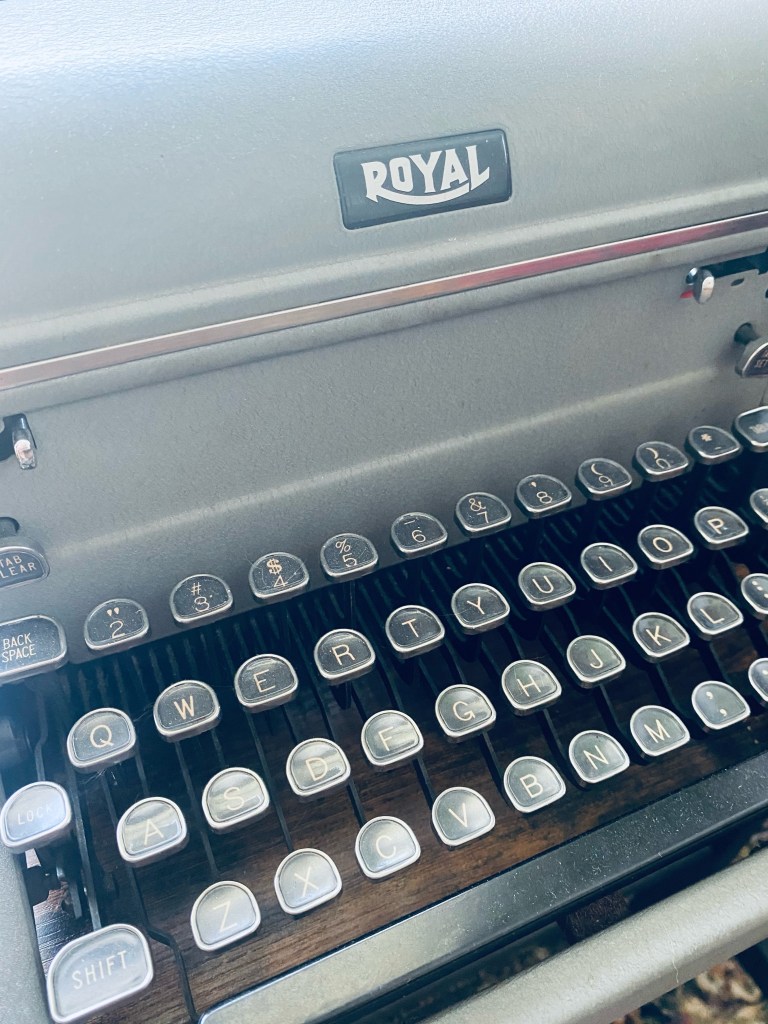
Whenever I’d go visit my grandparents, one of the first things I’d ask is for Pappy to bring out the heavy “ancient” machine and put it on the coffee table in the family room so I could “work.” I typed out letters, poems, stories, notes, and anything else I could think of that needed recording.

Now, that typewriter sits on a small table next to my desk in my home office, a constant reminder of my humble beginnings as a writer, and a daily inspiration for my passions.

And it serves not just as a reminder and inspiration, but I still actively use it.

When I founded Callahan Communication, I thought for a long time about what I wanted my value proposition to be. There are a lot of people out there who can do what I do, many charging less money… so how did I stand out?

I’ve written about why I chose a typewriter for my logo and it comes down to this – with today’s technology, anyone can be a “writer,” “social media specialist,” “marketer.” But not everyone can be an expert.

Social media marketing, content marketing, digital marketing, etc. all stem from the basic knowledge and understanding of marketing and people. And without that foundation of knowledge, it can be a challenge to be truly strategic, agile and successful.

That’s how I’m different. I have that foundation. I’ve been building it professionally for nearly 15 years, and on my own for more than two decades. I’ve lived it, breathed it, studied it, and put in my 10,000 hours of practice to become an expert.

And once you have that foundation built, it can be applied across the board for marketing and digital marketing. And I built my business to provide that expert consultation and delivery for my clients. While the tactics may change and adjust, the basics do not.

The typewriter, other than a pen and paper (which I still use as well), represents the basics of writing. Using a typewriter forces you to slow down and think about what you type. You can’t go back and make edits or additions. Once something is typed, there’s no delete or backspace. You have to have the foundation of what you’re writing, and it must be thought through and designed before starting.

Which is why I still use my typewriter. While my laptop allows me speed and flexibility, I like to go back to the basics. To challenge myself and feel the energy and motion of the keys as I type. And it’s the same as how I approach work with my clients – go back to the basics, challenge them, and apply it to today’s world. Build the foundation.

If you’re just starting out as a freelancer, I encourage you to think through your value proposition. What makes you different? Why are you the one the client should hire? Do you have the foundation necessary to be successful?

And if you’re already a successful freelancer, I challenge you to go back to the basics. What’s your foundation that you’re building upon? Is it stable? Do you need to revisit that foundation, those basics, to continue to be successful? I

Today, go back to your typewriter. Whatever that may be. And remember why you do what you do, and why you’re the best. Use that energy to push on, and continue providing your clients with the best.
brand guidelines

Whether you own a business, publish a blog, tweet using an alias, do freelance work, or something else along these lines, you’re likely doing so using a brand.

You may have intentionally created a brand, or it may be something that came naturally and just happened.

Or, like Callahan Communication, it may be a combination of both.

While I intentionally write blog posts and industry articles, built my website, and work with my clients using a brand I created, much of it also just happened because it was natural.

Something that didn’t happen naturally, though, and still takes effort, is keeping that brand.

Which is why this week I wanted to explore creating and following brand guidelines.

I’ve had to work within brand guideline constraints at every company I’ve ever worked for. It’s how we spoke, words we used, the tone we published in, the types of images and creative we promoted, the tactics we used. It was our logos, colors and typography.

And while I’ve owned this business for two years, I’ve never sat down and created brand guidelines for myself.

Since it’s only me, I never really felt the need. I generally used the same colors and font, same tone and types of content and imagery. But over the past few weeks I’ve felt a calling to sit down and create a brand guide book for myself as both something to follow in the future, and something to hold and be proud of.

I Googled “brand guidelines” and came across an article How to Create a Brand Style Guide in 5 Steps. I worked through each of the five steps, some taking a few days while others took just a few minutes. I found that much of it I’ve thought of before, such as my brand story, voice/tone, and logo. But some of it I’d never actually defined, like collecting brand inspiration and actually creating a brand color palette and typography sheet.

So I went to the store, bought poster board and a glue stick, and printed photos, colors, type, and other brand-related elements that inspired me. It made me feel stimulated, encouraged and motivated. It made me feel like, even after two years of working with clients and owning the business, I was actually a business.

And every time I look at that poster board, I get a little flutter in my stomach of excitement and pride.

(I also printed the same things, made some of my guidelines a little more formal, and placed them in plastic sheets in a binder to keep at my desk.)

So again, whether you own a business, publish a blog, tweet using an alias, do freelance work, or something else along these lines, you’re likely doing so using a brand.

And if you haven’t yet, I encourage you to sit down and create a brand style guide. It doesn’t have to be formal. In fact, it can be totally informal. Do whatever format works for, excites and inspires you. Put it somewhere you can see it – saved on your desktop, set as the background of your phone, hung on the wall above your desk, printed and placed in a binder.

Why?

It helps you be consistent. It shows prospective clients and your audience who you are without fail. It translates the heart, soul and mission of what you do into design and style, and should reflect that to others. It helps those who see your website, blogs/articles, social media content, and anything else you put into the universe, as yours. Your company. Your brand.

personalizing your brand

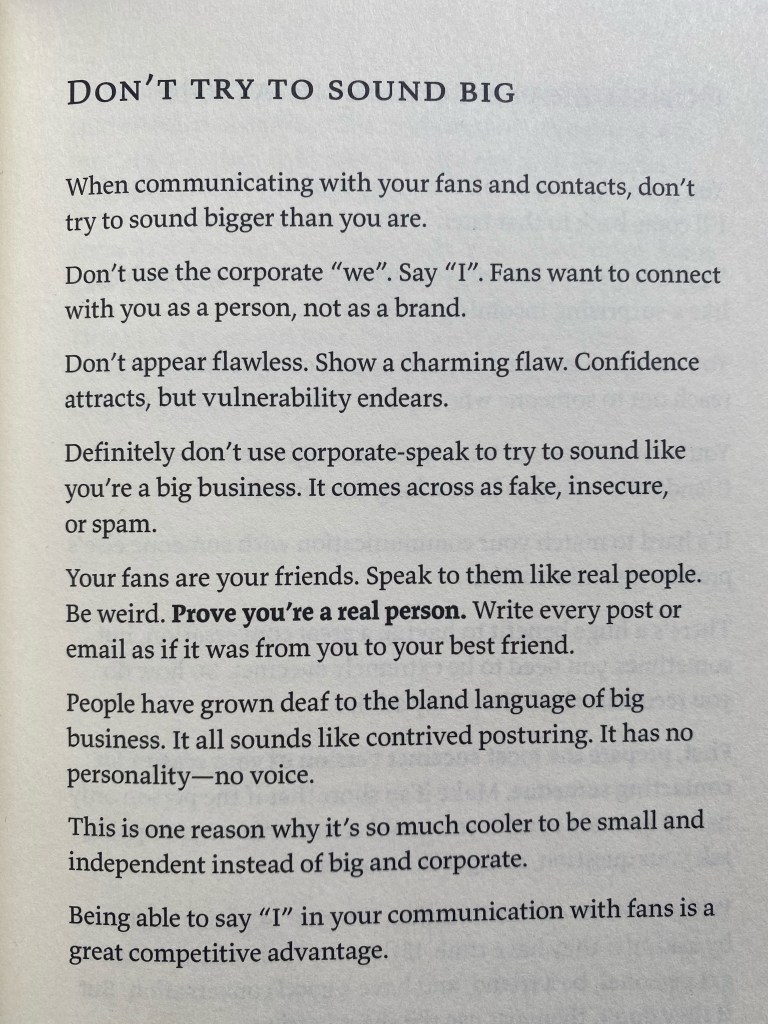
Earlier this week I posted about a chapter I read in Your Music and People: Creative and Considerate Fame by Derek Sivers. Just a few chapters later, I was inspired again and wanted to share it with you.

Because I am guilty of trying to sound big. And I’d venture a guess that, if you’re a freelancer or have your own small side-hustle, you are too.

I’ve struggled with should I say “we” or “I”? Should I speak as myself, or as a brand? Should I make myself sound bigger? Does that make my business better?

Because honestly, I am an agency of one. I am the only one who works for Callahan Communication. And I’ve wondered if that makes me look less legitimate, less trustworthy, and/or less appealing to clients.

So sometimes, when I’m writing a social media post or article for my site, I make myself sound like a larger business. (Which yes, I realize is the opposite stance I take with my blog posts.) But as I read this chapter (pictured above), I realized that while some clients may be turned off by my business of one, it’s also a huge advantage I have over others.

I’m a real person, not a huge company or brand. I’m sincere and honest. You know what you are getting if you partner with me. You can feel confident that when we sign a contract, I won’t farm the work out to a high school or college student looking to make a couple extra bucks. You can see my personality, and know exactly what I’m bringing to the table in our partnership. You can base your decision to work together off of reality, not a show put on by a marketing or PR team.

When I think about it, it is in fact much cooler to be small and independent instead of big and corporate, and I am proud to be able to say “I” in my communications and content. I’ve built this business with a lot of time, sweat and tears, and I am proud of and confident in what I provide my clients. I can showcase my passion, talent, experience and personality, and that’s one of the things that makes me a great partner.

I’ve done enough research and reading about how important it is to humanize your brand in order to connect with your audience. Consumers want to feel special, and like they are speaking to and engaging with a person, not a big company. I write about this and share it with clients. But I’m guilty of doing the opposite because I’m afraid of being small.

When in reality, I am the only human behind my brand, and everything you read from my company was written by me, for you. I want to engage with you. Educate you. Work with you. One on one. I want to help your business, make your marketing strategy better, and increase your leads and sales. And I’m excited to be able to offer that.

Moral of the story: Don’t be afraid to be small. Show your personality. Use your voice. Be a person, not a big company, no matter how large or small your company actually is. Appreciate and use your competitive advantage.

marketing = being considerate

A couple weeks ago I cruised through a book I got for Christmas – Your Music and People: Creative and Considerate Fame by Derek Sivers.

While he’s a musician writing about how to become successful as a musician, I was inspired by much of what he wrote and felt it was applicable to both myself and my side-hustle. One of the chapters I was first struck by is titled “‘Marketing’ Just Means Being Considerate.” He wrote:

Don’t confuse the word “marketing” with advertising, announcing, spamming or giving away branded crap.

Really, “marketing” just means being considerate.

Marketing means making it easy for people to notice you, relate to you, remember you, and tell their friends about you.

Marketing means listening for what people need, and creating something surprisingly tailored for them.

Marketing means getting to know people, making a deeper connection, and keeping in touch.

All of these are just considerate – looking at things from the other person’s point of view, and doing what’s best for them.

A lot of [musicians] say, “I hate marketing!” So, yah, if you thought marketing meant turning off your creativity, spending lots of money, and being annoying, then it’s a good thing you don’t like that. Nobody likes that.

Just find creative ways to be considerate. That’s the best marketing.

WOW.

I’ve been in the marketing industry for about a decade, and this perfectly sums up what my teams and I try to do every day, but in a way I’ve never thought of before. Because as marketers, we often make things more complicated than they need to be. Having the perfect creative, perfect copy, perfect landing page and calls to action, perfect audience, perfect platforms with perfect geofencing… the list goes on and on.

There is definitely a difference between ‘marketing’ and ‘advertising.’ But boiling ‘marketing’ down into those three “marketing means…” statements above hits the nail on the head.

How often, as with many aspects of life, do we make things more complicated than they need to be? Probably several times per day. Let’s take a moment to take a step back. What really matters? Why are we doing what we are doing? Who are we trying to help? What story are we trying to tell? Can it all boil down simply to being considerate? To being creative?

When applying this to your side-hustle or freelance career, think about what your ‘marketing’ and brand means. Are you making it easy for people to notice and relate to you? Will they remember you? Tell others about you? Are you listening to what people need? Getting to know them? Making connections? Doing what’s best for your clients? Until you answer yes to all of those questions, keep working. Keep striving to answer yes. Because once you do, I think you’ll find a whole new meaning to what you do.

I’m not there yet. But this year, you bet I’ll be working hard to make it.

it’s a digital world (part 2: content)

A couple weeks ago, I published part one of a three-part series sharing some of my favorite statistics supporting social media marketing and how it can change the way you market and share your business.

Today, I want to talk about a concept that’s challenging to understand, and sometimes even more challenging to implement: content marketing.

Perhaps you’ve:

  1. Never thought about content marketing.
  2. Have thought about it, but don’t know how it applies to your brand or how it can help generate sales.
  3. Attempted to implement it in your marketing strategy, but aren’t really sure how to execute, feel stuck, or simply don’t have time.

IMPORTANT NOTE: “Content marketing” doesn’t have to mean blogs, though that is the primary tool for most businesses. It can also mean social media posts, video, photos, memes, emails, whitepapers, ebooks, podcasts, and more. The options are endless, and chances are you can find a form of content that works for you and your business.

If you’ve never thought about it, or think I’m crazy to suggest content marketing can help improve customer retention and drive sales, here are a few stats that may convince you otherwise.

  • 77% of internet users read blogs. However, nearly 30% of users block advertising on their connected devices.
  • Content marketing gets 3x the leads per dollar spent when compared to paid search tactics. It also costs an average of 41% less.
  • It generates more than 3x as many leads and costs 62% less than other outbound marketing tactics.
  • Small businesses with blogs get 126% more lead growth than small businesses without.
  • 61% of online consumers make a purchase after reading recommendations on a blog.
  • Content marketing conversion rates are 6x higher than other traditional marketing methods.
  • Websites with blogs have 434% more search engine-indexed pages than those without blogs, meaning significantly more traffic to your website.
  • 70% of people would rather get information about or learn something from a company from an article or blog post rather than traditional advertising tactics.

I could get into stats about individual forms of content and how they can push your business to the next level, but I won’t here because that could be a 10,000 word whitepaper. The point is, content marketing is important, cheap, and can help boost your business and retain your customers.

Plus, the good news is you don’t have to be an “expert” to do content marketing. With today’s technology, building a website, editing a video, posting a photo, or even recording a podcast can be as simple as clicking a few buttons. And while you don’t want to put out bad content that could hurt your brand or business, attempting something can many times be better than nothing.

It can feel overwhelming to get started. But remember – no one knows your business, brand and products/services better than you. Think about what you can share with others regarding your brand. What’s your story? What are the questions your customers are asking? How can you be a solution? What do your customers like, and how can you engage and entertain them through different forms of content?

Check out some of these posts on how to develop a content strategy and get started.

If you want to talk further about how content marketing can help your business, need help getting started, or would like assistance with ongoing support, send me a message today