why I still use a typewriter

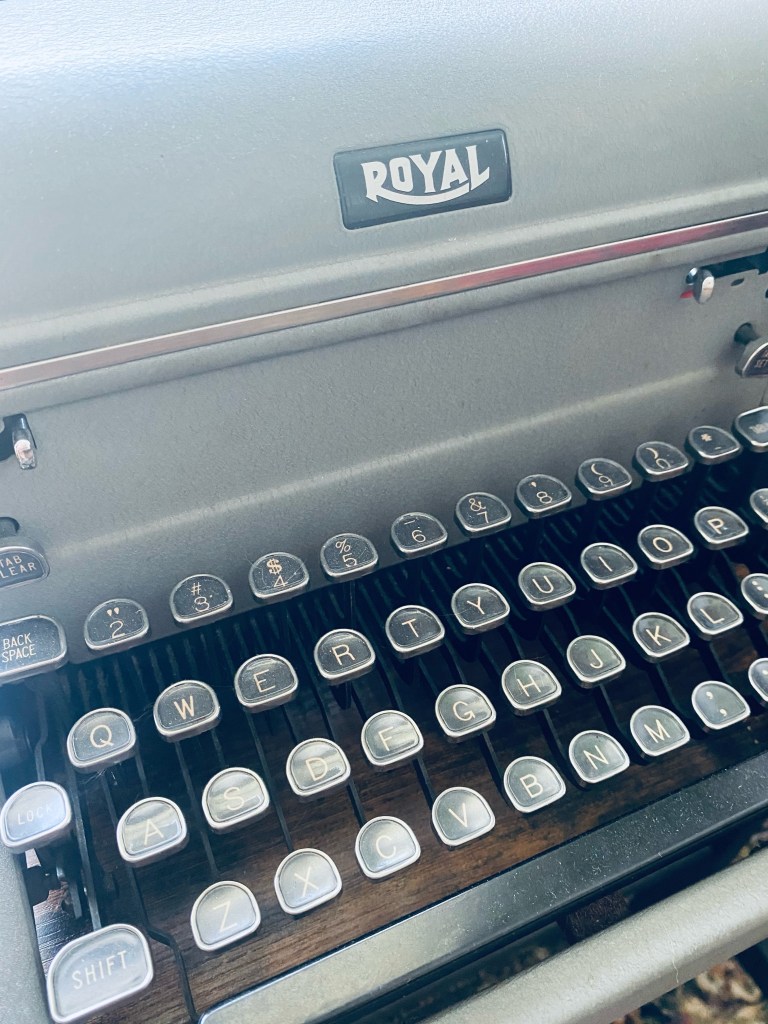
My writing career started on a typewriter when I was just six or seven years old.

Whenever I’d go visit my grandparents, one of the first things I’d ask is for Pappy to bring out the heavy “ancient” machine and put it on the coffee table in the family room so I could “work.” I typed out letters, poems, stories, notes, and anything else I could think of that needed recording.

Now, that typewriter sits on a small table next to my desk in my home office, a constant reminder of my humble beginnings as a writer, and a daily inspiration for my passions.

And it serves not just as a reminder and inspiration, but I still actively use it.

When I founded Callahan Communication, I thought for a long time about what I wanted my value proposition to be. There are a lot of people out there who can do what I do, many charging less money… so how did I stand out?

I’ve written about why I chose a typewriter for my logo and it comes down to this – with today’s technology, anyone can be a “writer,” “social media specialist,” “marketer.” But not everyone can be an expert.

Social media marketing, content marketing, digital marketing, etc. all stem from the basic knowledge and understanding of marketing and people. And without that foundation of knowledge, it can be a challenge to be truly strategic, agile and successful.

That’s how I’m different. I have that foundation. I’ve been building it professionally for nearly 15 years, and on my own for more than two decades. I’ve lived it, breathed it, studied it, and put in my 10,000 hours of practice to become an expert.

And once you have that foundation built, it can be applied across the board for marketing and digital marketing. And I built my business to provide that expert consultation and delivery for my clients. While the tactics may change and adjust, the basics do not.

The typewriter, other than a pen and paper (which I still use as well), represents the basics of writing. Using a typewriter forces you to slow down and think about what you type. You can’t go back and make edits or additions. Once something is typed, there’s no delete or backspace. You have to have the foundation of what you’re writing, and it must be thought through and designed before starting.

Which is why I still use my typewriter. While my laptop allows me speed and flexibility, I like to go back to the basics. To challenge myself and feel the energy and motion of the keys as I type. And it’s the same as how I approach work with my clients – go back to the basics, challenge them, and apply it to today’s world. Build the foundation.

If you’re just starting out as a freelancer, I encourage you to think through your value proposition. What makes you different? Why are you the one the client should hire? Do you have the foundation necessary to be successful?

And if you’re already a successful freelancer, I challenge you to go back to the basics. What’s your foundation that you’re building upon? Is it stable? Do you need to revisit that foundation, those basics, to continue to be successful? I

Today, go back to your typewriter. Whatever that may be. And remember why you do what you do, and why you’re the best. Use that energy to push on, and continue providing your clients with the best.

in with the old

Recently I was messaged by a client I worked with in the past asking if I was still writing, and if I’d be able to help them with some content needs they had.

This client was one of the first I ever had on Upwork (in fact, I think he was the second). The pay was great (at the time), I was enjoying the content topics and writing, and he was an easy client to work with.

However, due to personal things going on at the time that took up a lot of mental space, and a lack of true commitment to freelancing (mostly because I was overwhelmed), I didn’t provide the best experience that this client deserved. We worked together on and off for a year, and then I basically ghosted them and one year later, ended the contract.

I was shocked when he reached back out. Because while the content I provided was exceptional, the rest of the relationship wasn’t. I’m embarrassed with how I handled our contract. I’ll be honest.

But I’ve come a long way in the past year and a half. And so when I got his message asking if I could do some work, I decided that, as embarrassed as I was, it was my duty to show up and prove my worth. To repair that relationship, and in addition to providing exceptional work, go above and beyond with my customer service.

It’s just the right thing to do.

The more I think about it, I’m willing to bet that I’m not the only freelancer/business owner out there who is disappointed in themselves for how they handled a contract, sale, client relationship, whatever. We probably all have that one or two clients or customers who haunt us and keep us up at night.

Because over time, we’ve grown. We’ve gotten better. We’ve learned to thrive. And those marks on our record are hard to forget.

And this past week I realized the important thing is… you’ve grown. And you’ve gotten better. And you’ve learned to thrive.

And it’s ok to have those ghosts.

Because we were learning. We were just figuring things out. We were overwhelmed, taking on too much too fast, or drowning while trying to find the balance between life, work and side-hustle work.

It’s not ok now. I won’t accept anything but the best for my clients. And I’ll never have more ghosts that keep me up at night. (Or at least I’ll do everything I can to make sure that doesn’t happen.)

But I fully believe part of growing your business is ensuring you grow as a person, both personally and professionally. While I improve my craft and learn more about industries and writing and content, I also improve how I communicate with clients, meet deadlines, stay organized, and build relationships.

That’s what’s important.

If you have those ghosts, don’t forget them. Let them push you to grow and be better. But don’t let them hold you back. It’s part of life. It’s part of owning and growing a business. It’s part of freelancing.

Is there a point to this blog post? Not really. But I felt it important to recognize that we all mess up sometimes. We all make mistakes that we have to learn and grow from. It’s part of what we do. But as long as we don’t do it again, and are constantly improving, it’s ok.

And, it’s even better if one of those old mistakes comes back and gives you a second chance to prove yourself.

brand guidelines

Whether you own a business, publish a blog, tweet using an alias, do freelance work, or something else along these lines, you’re likely doing so using a brand.

You may have intentionally created a brand, or it may be something that came naturally and just happened.

Or, like Callahan Communication, it may be a combination of both.

While I intentionally write blog posts and industry articles, built my website, and work with my clients using a brand I created, much of it also just happened because it was natural.

Something that didn’t happen naturally, though, and still takes effort, is keeping that brand.

Which is why this week I wanted to explore creating and following brand guidelines.

I’ve had to work within brand guideline constraints at every company I’ve ever worked for. It’s how we spoke, words we used, the tone we published in, the types of images and creative we promoted, the tactics we used. It was our logos, colors and typography.

And while I’ve owned this business for two years, I’ve never sat down and created brand guidelines for myself.

Since it’s only me, I never really felt the need. I generally used the same colors and font, same tone and types of content and imagery. But over the past few weeks I’ve felt a calling to sit down and create a brand guide book for myself as both something to follow in the future, and something to hold and be proud of.

I Googled “brand guidelines” and came across an article How to Create a Brand Style Guide in 5 Steps. I worked through each of the five steps, some taking a few days while others took just a few minutes. I found that much of it I’ve thought of before, such as my brand story, voice/tone, and logo. But some of it I’d never actually defined, like collecting brand inspiration and actually creating a brand color palette and typography sheet.

So I went to the store, bought poster board and a glue stick, and printed photos, colors, type, and other brand-related elements that inspired me. It made me feel stimulated, encouraged and motivated. It made me feel like, even after two years of working with clients and owning the business, I was actually a business.

And every time I look at that poster board, I get a little flutter in my stomach of excitement and pride.

(I also printed the same things, made some of my guidelines a little more formal, and placed them in plastic sheets in a binder to keep at my desk.)

So again, whether you own a business, publish a blog, tweet using an alias, do freelance work, or something else along these lines, you’re likely doing so using a brand.

And if you haven’t yet, I encourage you to sit down and create a brand style guide. It doesn’t have to be formal. In fact, it can be totally informal. Do whatever format works for, excites and inspires you. Put it somewhere you can see it – saved on your desktop, set as the background of your phone, hung on the wall above your desk, printed and placed in a binder.

Why?

It helps you be consistent. It shows prospective clients and your audience who you are without fail. It translates the heart, soul and mission of what you do into design and style, and should reflect that to others. It helps those who see your website, blogs/articles, social media content, and anything else you put into the universe, as yours. Your company. Your brand.

personalizing your brand

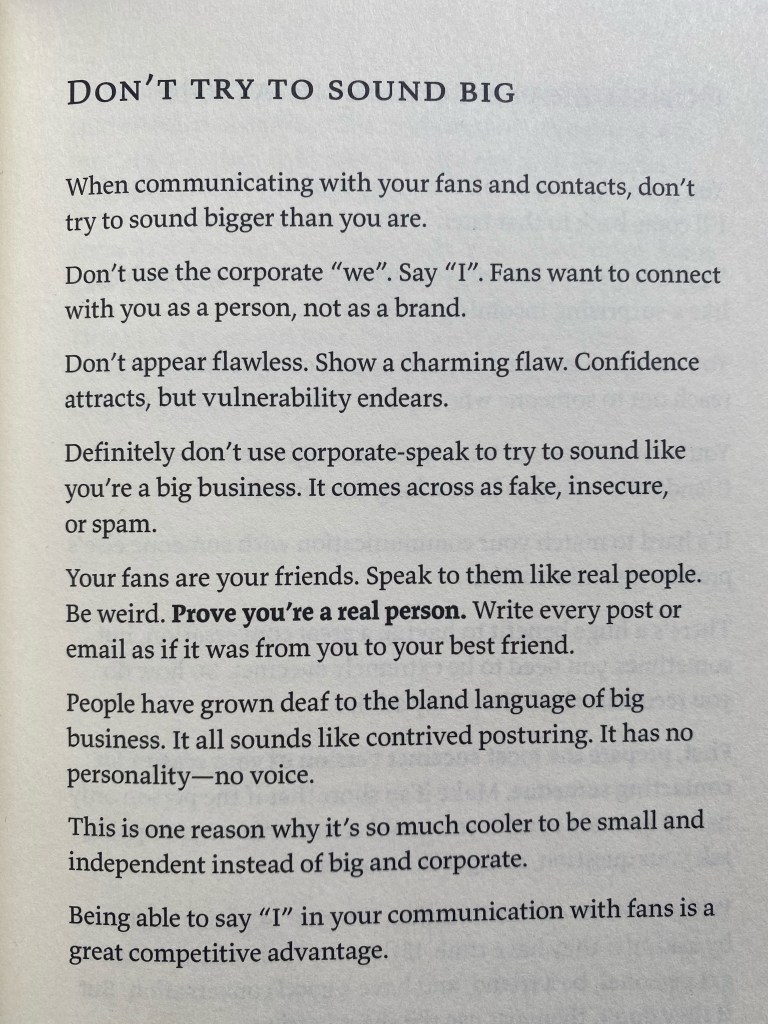
Earlier this week I posted about a chapter I read in Your Music and People: Creative and Considerate Fame by Derek Sivers. Just a few chapters later, I was inspired again and wanted to share it with you.

Because I am guilty of trying to sound big. And I’d venture a guess that, if you’re a freelancer or have your own small side-hustle, you are too.

I’ve struggled with should I say “we” or “I”? Should I speak as myself, or as a brand? Should I make myself sound bigger? Does that make my business better?

Because honestly, I am an agency of one. I am the only one who works for Callahan Communication. And I’ve wondered if that makes me look less legitimate, less trustworthy, and/or less appealing to clients.

So sometimes, when I’m writing a social media post or article for my site, I make myself sound like a larger business. (Which yes, I realize is the opposite stance I take with my blog posts.) But as I read this chapter (pictured above), I realized that while some clients may be turned off by my business of one, it’s also a huge advantage I have over others.

I’m a real person, not a huge company or brand. I’m sincere and honest. You know what you are getting if you partner with me. You can feel confident that when we sign a contract, I won’t farm the work out to a high school or college student looking to make a couple extra bucks. You can see my personality, and know exactly what I’m bringing to the table in our partnership. You can base your decision to work together off of reality, not a show put on by a marketing or PR team.

When I think about it, it is in fact much cooler to be small and independent instead of big and corporate, and I am proud to be able to say “I” in my communications and content. I’ve built this business with a lot of time, sweat and tears, and I am proud of and confident in what I provide my clients. I can showcase my passion, talent, experience and personality, and that’s one of the things that makes me a great partner.

I’ve done enough research and reading about how important it is to humanize your brand in order to connect with your audience. Consumers want to feel special, and like they are speaking to and engaging with a person, not a big company. I write about this and share it with clients. But I’m guilty of doing the opposite because I’m afraid of being small.

When in reality, I am the only human behind my brand, and everything you read from my company was written by me, for you. I want to engage with you. Educate you. Work with you. One on one. I want to help your business, make your marketing strategy better, and increase your leads and sales. And I’m excited to be able to offer that.

Moral of the story: Don’t be afraid to be small. Show your personality. Use your voice. Be a person, not a big company, no matter how large or small your company actually is. Appreciate and use your competitive advantage.

ghostwriting

Let me preface this post by stating that ghostwriting isn’t “bad,” and there’s nothing “wrong” with doing it. However, it may not be for everyone, so being aware of what it is and determining whether or not you want to do it is an important step in your freelance career.

Ghostwriting is when something you write or produce is credited to another author. For example, though you, Jane Doe, may write the blog post, it may be published on the client’s website under the CEO’s name “John Smith.”

Pros

  • It’s experience.
  • You can gain experience in a variety of industries and niches, some of which you wouldn’t get if you were credited.
  • You can write about topics that you aren’t necessarily an “expert” in and aren’t your primary focus. You can also write about new topics without having to worry about public perceptions tied to your name attached to them.
  • You can work on a secret passion.

Cons

  • You don’t get credit for writing a piece.
  • In most cases, you can’t include ghostwritten pieces in a portfolio or on a resume. You may even be required to sign a non-disclosure agreement (NDA) and can’t claim or share involvement with the project or client.
  • You give up ownership of the work.

In some cases, it doesn’t matter if your name is attached to work. For example, perhaps you write press releases, copy for client websites and landing pages, or social media posts. The important thing here (if it’s important to you) is to understand if you can list the client as a client in your portfolio, and reference the work you complete.

However, in most cases, if you’re contributing to a book, writing blog pieces, articles or other content, producing art or graphics, etc., it can be beneficial to have your name in the byline. This way you can list or link to those pieces in your portfolio, share them with prospective future clients, and build your brand and reputation around your name.

If you ask some freelancers, or do a quick internet search, many consider ghostwriting to be a form of plagiarism because someone is claiming someone else’s work as their own.

If you sign up to be a ghostwriter, this shouldn’t be a problem. However, if you don’t, it could be.

Personally I don’t bid for or accept ghostwriting jobs because it’s important to me to be able to build my portfolio, brand and company. (There are exceptions, of course, for jobs in which I can reference the client and work, such as running a company’s social media account.)

However, I recently realized some of my work for clients is being published under other names – turns out, I was hired as a ghostwriter. This wasn’t disclosed up front. But this isn’t illegal.

Clients don’t have to tell you that you’re ghostwriting for them, and that’s fine.

Moving forward, it will become part of my regular practice to ask up front:

  • Can I list you as a client in my portfolio?
  • Will I be getting credit for this work?
  • Can I link to this work in my portfolio/share it in the future?

I used to do this when I first started. I worked with some amazing clients, and became lax with my clarification. No longer, because as proud as I am of the work I’m producing, I can’t claim it and I can’t use it.

Again, if you don’t mind not having your name attached to something, or perhaps you prefer anonymity, ghostwriting can be a great opportunity.

TIP: If those things are important to you, be sure to clarify with the client up front what your relationship can be with the work you produce. Don’t be afraid to ask if you’ll be getting credit, or how you can use the work in the future. If you’re working with clients outside of a freelancer service (like Upwork) always include copyright, future use and client relationship information in your contract. Or, be sure to understand what the client’s contract states about these before entering the agreement.