In January, I finished the book Onward by Howard Shultz, founder and two-time ceo of one of the most well-known brands in the world: Starbucks. In the book, he wrote about his inspiration for Starbucks and how the company began, and how he grew it into the brand we know and love today. However, even Starbucks wasn’t without struggles, as it saw significant financial difficulty in 2008 that took several years to overcome.
Personally, I’ve never been a huge Starbucks fan. Blasphemy, I know.
Most of the drinks were too sweet and even not-very-health-conscious me had a hard time putting those sugar packed liquids into my body. Then, the regular coffee tasted fine, but not good enough for me to pay $4 for. One thing I did always love and gave credit to was the atmosphere and the customer service, but I didn’t give myself much luxury to thoroughly enjoy it.
While reading Onward, I felt almost guilty for feeling the way I did about Starbucks. Howard was that inspirational and motivational. His passion and love for his company was almost tangible, even through a book. And I found myself highlighting, marking and sticky-noting several passages throughout the chapters with advice on business and life.
How Howard built Starbucks, with the passion and love, ingenuity, creativity and drive, is how I envision running my own business.
Not on the same level… obviously.
But with the same passion, creativity, drive and love for my work and customers that he had.
There was one particular passage at the end of the book that I both highlighted and sticky-noted so I would double remember. In fact, I might get it printed on something to hang above my desk.
Grow with discipline. Balance intuition with rigor. Innovate around the core. Don’t embrace the status quo. Find new ways to see. Never expect a silver bullet. Get your hands dirty. Listen with empathy and overcommunicate with transparency. Tell your story, refusing to let others define you. Use authentic experiences to inspire. Stick to your values, they are your foundation. Hold people accountable but give them the tools to succeed. Make the touch choices; it’s how you execute that counts. Be decisive in times of crisis. Be nimble. Find truth in trials and lessons in mistakes. Be responsible for what you see, hear and do. Believe.
I got goosebumps when I read that. Because not only can I apply that advice to running my business, but it’s also applicable to every day life. To my 9-5 job. To being a leader.
I think every leader in every organization should read this. Embrace it. Embody it.
My advice to you is to read, embrace and embody those words. Share with leaders in your life. Use it as a foundation for your business or career. You never know where it can take you or how successful you can be.
(After all, it comes from a man who built a company with a net worth of several billion dollars and instant brand recognition all over the world.)
Also, I highly recommend the whole book. Definitely a great read!
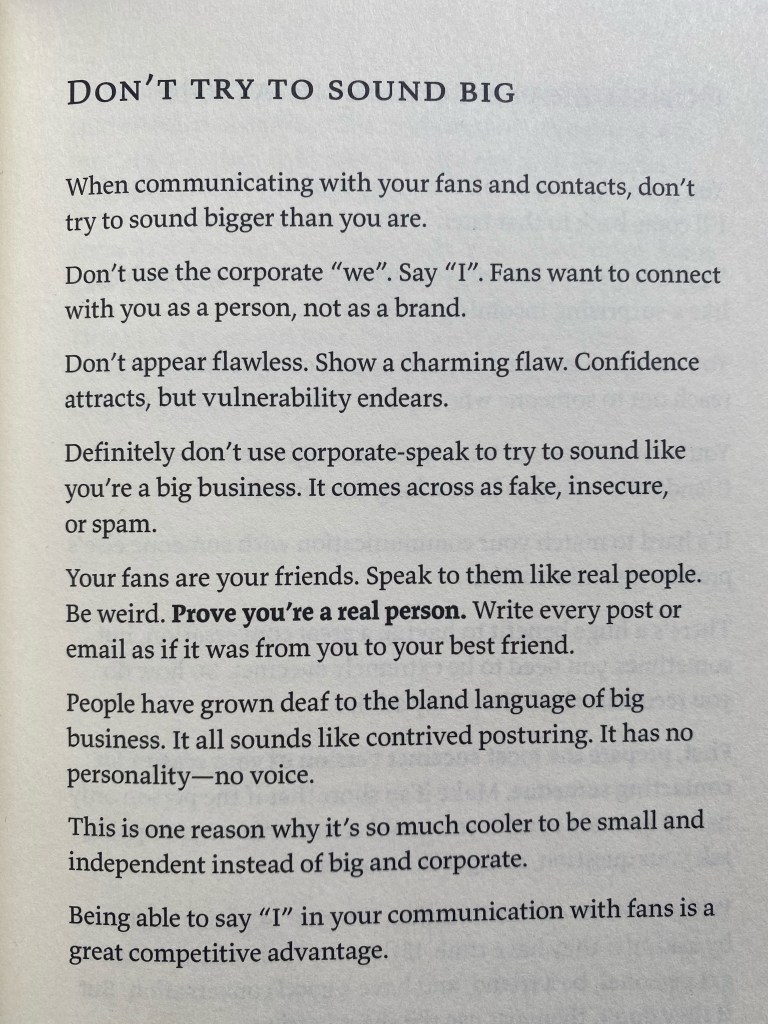
Earlier this week I posted about a chapter I read in Your Music and People: Creative and Considerate Fame by Derek Sivers. Just a few chapters later, I was inspired again and wanted to share it with you.
Because I am guilty of trying to sound big. And I’d venture a guess that, if you’re a freelancer or have your own small side-hustle, you are too.
I’ve struggled with should I say “we” or “I”? Should I speak as myself, or as a brand? Should I make myself sound bigger? Does that make my business better?
Because honestly, I am an agency of one. I am the only one who works for Callahan Communication. And I’ve wondered if that makes me look less legitimate, less trustworthy, and/or less appealing to clients.
So sometimes, when I’m writing a social media post or article for my site, I make myself sound like a larger business. (Which yes, I realize is the opposite stance I take with my blog posts.) But as I read this chapter (pictured above), I realized that while some clients may be turned off by my business of one, it’s also a huge advantage I have over others.
I’m a real person, not a huge company or brand. I’m sincere and honest. You know what you are getting if you partner with me. You can feel confident that when we sign a contract, I won’t farm the work out to a high school or college student looking to make a couple extra bucks. You can see my personality, and know exactly what I’m bringing to the table in our partnership. You can base your decision to work together off of reality, not a show put on by a marketing or PR team.
When I think about it, it is in fact much cooler to be small and independent instead of big and corporate, and I am proud to be able to say “I” in my communications and content. I’ve built this business with a lot of time, sweat and tears, and I am proud of and confident in what I provide my clients. I can showcase my passion, talent, experience and personality, and that’s one of the things that makes me a great partner.
I’ve done enough research and reading about how important it is to humanize your brand in order to connect with your audience. Consumers want to feel special, and like they are speaking to and engaging with a person, not a big company. I write about this and share it with clients. But I’m guilty of doing the opposite because I’m afraid of being small.
When in reality, I am the only human behind my brand, and everything you read from my company was written by me, for you. I want to engage with you. Educate you. Work with you. One on one. I want to help your business, make your marketing strategy better, and increase your leads and sales. And I’m excited to be able to offer that.
Moral of the story: Don’t be afraid to be small. Show your personality. Use your voice. Be a person, not a big company, no matter how large or small your company actually is. Appreciate and use your competitive advantage.
A couple weeks ago I cruised through a book I got for Christmas – Your Music and People: Creative and Considerate Fame by Derek Sivers.
While he’s a musician writing about how to become successful as a musician, I was inspired by much of what he wrote and felt it was applicable to both myself and my side-hustle. One of the chapters I was first struck by is titled “‘Marketing’ Just Means Being Considerate.” He wrote:
Don’t confuse the word “marketing” with advertising, announcing, spamming or giving away branded crap.
Really, “marketing” just means being considerate.
Marketing means making it easy for people to notice you, relate to you, remember you, and tell their friends about you.
Marketing means listening for what people need, and creating something surprisingly tailored for them.
Marketing means getting to know people, making a deeper connection, and keeping in touch.
All of these are just considerate – looking at things from the other person’s point of view, and doing what’s best for them.
A lot of [musicians] say, “I hate marketing!” So, yah, if you thought marketing meant turning off your creativity, spending lots of money, and being annoying, then it’s a good thing you don’t like that. Nobody likes that.
Just find creative ways to be considerate. That’s the best marketing.
WOW.
I’ve been in the marketing industry for about a decade, and this perfectly sums up what my teams and I try to do every day, but in a way I’ve never thought of before. Because as marketers, we often make things more complicated than they need to be. Having the perfect creative, perfect copy, perfect landing page and calls to action, perfect audience, perfect platforms with perfect geofencing… the list goes on and on.
There is definitely a difference between ‘marketing’ and ‘advertising.’ But boiling ‘marketing’ down into those three “marketing means…” statements above hits the nail on the head.
How often, as with many aspects of life, do we make things more complicated than they need to be? Probably several times per day. Let’s take a moment to take a step back. What really matters? Why are we doing what we are doing? Who are we trying to help? What story are we trying to tell? Can it all boil down simply to being considerate? To being creative?
When applying this to your side-hustle or freelance career, think about what your ‘marketing’ and brand means. Are you making it easy for people to notice and relate to you? Will they remember you? Tell others about you? Are you listening to what people need? Getting to know them? Making connections? Doing what’s best for your clients? Until you answer yes to all of those questions, keep working. Keep striving to answer yes. Because once you do, I think you’ll find a whole new meaning to what you do.
I’m not there yet. But this year, you bet I’ll be working hard to make it.
If one of your goals for 2021 is to build your book of business, hopefully you’ve already started taking steps toward accomplishing that goal. Soon, you’ll have clients accepting your bids and proposals to begin working together.
When a client reaches out to you to start a working relationship, it’s important to remember the relationship should be mutually beneficial – you get a client and a paycheck, and they get the services they need and are hiring you for.
That being said, when talking with a client and determining whether or not that relationship is the right fit, you are just as much interviewing them as they are you.
When I first started Upwork, I quickly learned I was not in charge of my own freelancer destiny… the client was. I had to apply to the job, compete with sometimes dozens of other freelancers, be interviewed by the client and even occasionally do a “test” project. Sometimes I got the contract, sometimes I didn’t. And while I’m not under the delusion that clients will come flocking to me and let me do my best work as I wanted, I had a lot less control than I had originally dreamed of.
And, letting my clients run completely run the show has led me into situations where I had to end the contract because the relationship wasn’t right (see my post on when it’s not a good fit).
What I’ve learned (sometimes the hard way) is that in order to have a lasting relationship, I must be an active participant in the beginning. I can’t just sit back and just be grateful to have the contract (though I am incredibly grateful). I have to respect and stand up for myself and my business.
Much like a traditional job interview, it’s important to do the appropriate research and ask the right questions before deciding whether to move forward working together or not.
First, research the company/person.
Check out their website and social media presence. Try to understand their current brand presence and engagement with audiences.
Read any reviews on social or Google.
Check Glassdoor to read what previous employees have to say about them.
If you’re on a platform like Upwork, read the reviews from past freelancers they worked with.
Ask questions. Some questions I ask include (but are not limited to):
What is your website/the website my work will be showcased on? Do you have any brand guidelines or information about your company/product/service/brand you can share? (I like to ask for as much information up front so I can really dive into and understand the client.)
What are your expectations as far as work load, deadlines, and rate?
What are the expectations for this job? (For example, will I be provided with a topic/outline and have to simply write the post, or would you like me to pitch ideas to write? Will I have to find images, post to the website, etc.?)
How long would you anticipate the contract or our relationship lasting?
Would you be ok with me listing you as a client in my portfolio, and/or linking to any of my work you publish?
Try to understand the client and company as well as the job you’ll be contracting for. The more you can get a feel for the client and expectations up front, the more likely you are to have a positive working relationship moving forward.
If you don’t have a formal “interview” process, send questions in an email or ask to chat with them before finalizing the contract. This is so important.
Next, be clear (respectfully) what your expectations are as the freelancer.
If you aren’t comfortable with something they are asking you to do, or you prefer to work a different way, share that information. (Again, respectfully.)
If their proposed rate is too low, negotiate.
Outline communication expectations (via phone, email, Slack/Trello/another platform, etc., how often, will you be required to have “meetings,” etc.)
Share your preferred way to invoice and discuss expectations for payment.
Do you offer revisions? How many rounds are built into the rate? What if more revisions are necessary?
Finally, be personable.
Whether you’re working with this client on one assignment, or the contract is long-term for the next several months or even years, it’s important to establish a great rapport with the client. This helps ensure a positive working environment and relationship for both of you throughout the contract, and increases the likelihood they will 1) come back to you in the future if they need work, or 2) recommend you to others.
Connect with them on some personal level. You don’t have to share each other’s life stories or be too detailed or intimate, but don’t forget you are both people, and connecting on a deeper level will help make the contract go smoother.
Do you have any tips for interviewing your clients? What helps you establish a great working relationship right off the bat?
Is one of your goals this year to grow your book of business?
In order to do this, you’re going to have to perfect the art of pitching and bidding for contracts.
While I wouldn’t classify myself as an expert, I have personally submitted hundreds of pitches and done quite a bit of reading/research on how to win a contract. This is especially important when I’m bidding on contracts through Upwork since there is no limit on how many others can also bid, and I could be competing with tens of others.
When you pitch work to a company or bid for a contract, the keys are to:
Stand out
Be memorable
Quickly showcase your qualifications and why you are the best fit
This includes whether you’re bidding for a posted contract or pitching your business to a prospective client.
So, how do you do this? Especially within just a few sentences or short paragraphs? Here are a few things I’ve learned and recommend.
Bidding for a Posted Contract
If you’re using a freelancer service such as Upwork, or applying for jobs posted on a job network like LinkedIn, these tips may be applicable to you.
Carefully read the job description. Make sure you understand everything the client is looking for. Not only do you want to ensure it’s something you’re actually interested in, but also something you’re qualified for. Sometimes clients are looking for specific expertise or tasks that may not be applicable to you.
Look to see if the client included a proposedrate in the description, which can either encourage or deter you from applying. Check for links to their website or additional information. Finally, some clients will include words/phrases to include in your pitch (to ensure you read the job description), or questions they want you to answer ahead of time.
Tailor your pitch to the job specifics. I, like I’d imagine many other freelancers, have a generic pitch typed and saved on my computer. Whenever I’m applying for contracts, I copy and paste that into the application. While I’ll talk later about what I actually include in it, one thing I do for each job is tailor the pitch to the job.
If the client is looking for a blogger, I focus on my blog experience and expertise. If they are in need of a social media manager, I share my experience in social. Same with proofreading or digital marketing consulting.
Then, I try to take it one step further. If the client is a pet food business, I share something personal about my pets at home. If they need insurance content, I highlight my experience specifically with insurance. The point is to get the job, so make sure the client knows you are the one for their specific job.
Highlight specific qualities. This goes hand in hand with tailoring your pitch to the job, but focuses on specifics about you and your experience. Is there a particular client you’ve worked with or experience you have that makes you more qualified than others? Can you share statistics you have on ROI or engagement with content you created? Be specific about why you are best for the job.
Link to your website or portfolio. This is an important step in setting yourself apart from other applicants. First, if a client sees your website or portfolio in your pitch, they may see you in a more professional light.
You also give them an opportunity to screen you before wasting each other’s time with follow up communications or interviews. They can look at your site or experience and determine whether or not you are right for their brand or job, and decide whether or not to move forward.
Consider including your rate. Whether or not you do this can be subject to change based on the job. If the client asks for your rate, you should probably include it. If not, you can decide based on information you have about the client, or proposed rate they have in the job description, whether or not you’d like to include rate out front.
The key is to find the sweet spot that doesn’t scare the client away, but also doesn’t let them think they can take advantage of you. Perhaps try to avoid including a specific rate, and instead give a range. Or, my go to statement is: I’m happy to negotiate a per word or per article rate. This gives us both flexibility but keeps the ball in my court, because I can say yes or no to what they say.
Pitching Your Business to a Prospect Client
If you’re at the point in your career where you’re “cold-selling” yourself to businesses to bring them on as new clients, that’s great! Many freelancers start small with people they know, or businesses in their local community. Or, perhaps you’re ready to expand to those you don’t know or who are larger or even national. These tips may help with your endeavors.
Do your research. One of the worst things you can do is pitch to a prospective client without having done research on their brand. While you’re doing research for yourself, much like prepping for a job interview, you also want to know the exact areas where you can help.
Understand as much as you can about their products/services. Learn about their values and brand, including the tone and feel.
Spend time on their website and check out their blog.
Visit their pages on different social media platforms like Facebook, Twitter, Instagram and YouTube. What type of content do they post? How do they engage with their customers? How do customers engage with them?
Search them on Google. Does their website appear? Do they have any Google reviews? Are there any articles about them?
Find the important people on LinkedIn and Google. This may include the owner, CEO, CMO, someone from HR, or whomever you are pitching to or want to talk to. What is their experience? How long have they been with the company? Can you find out anything personal that you can relate to?
Tailor your pitch to the client. Similar to pitching for a specific job, you want to tailor your pitch to the client. The client shouldn’t feel like you just blasted out the same pitch to 10 different businesses. Help them understand their business is important to you, and make them feel like they are the only client that matters. Also try referencing things you learned about them or their brand in your research.
Be specific. This is two-fold to answer two questions: How can you help them, and why should they hire you?
It’s critical that you do not criticize the brand. Don’t list what they are doing wrong. Instead, encourage them that you can help it be even better. Maybe you can help with training the current marketing person. Or, perhaps marketing is being done by the owner of the business and you can simply free up their time for more important things. Be positive about what you reference and how you phrase how you can help.
Additionally, be specific about why they should hire you. Talk about your experience, involvement with the community, past experiences with the company. Include stats or information that provides context or support to your experience.
Be personable. You’re hoping to build a long-term working relationship with this client, so make sure they see you as a person they can work with. Include something about yourself, or how the company personally interests you. For example, you love this locally-owned pet store and have made several purchases from there yourself for your own fur baby.
People like working with people, and since they don’t know you and didn’t approach your first, you want to make sure they know you mean well, you can help them improve their customer acquisition/retention/whatever goal you want to help with, and that you are a great person to work with.
Link to your website, portfolio, and client testimonials. Again, this gives a sense of professionalism right off the bat. Plus, the prospective client likely doesn’t know you or exactly what you can provide. By linking to your site, you give them the opportunity to research you and understand what your business is all about to help decide whether or not they want to hire you.
What to Include in Your Pitch
Keeping the above tips in mind, here are a few things I try to include in every pitch. Typically, I try to keep mine between 250-300 words – short, sweet and to the point. Yours may be shorter or longer depending on the client or job.
A brief explanation of my experience, including college education and years in the industry.
A brief overview of the type of clients I’ve had and industries I’ve worked in (specific to the job, such as blog writing or social media marketing).
One sentence about where my specific expertise lies.
One to two sentences specific to the job/client and specific experience I have related to it. Or, a short narrative that makes me relatable.
A link to my portfolio.
One sentence about certifications I hold.
If applicable, one sentence about rate.
A closing, encouraging reach out to me with any questions, thanking them for their time, and sharing my excitement about discussing next steps.





 callahancommunication.com